Why the Staenis grid makes stresses in screed smaller
By Staenis |
A traditional floating screed behaves like one large slab. Shrinkage, drying and temperature differences can therefore build up stress over a large area. The Staenis grid approaches that problem differently: it makes the stress fields smaller.
In this blog, we explain why the Staenis screed grid changes the mechanical behaviour of the screed. Want to know which build-up fits your project? View the floor build-ups or calculate your materials with the calculator.
What happens with traditional screed?
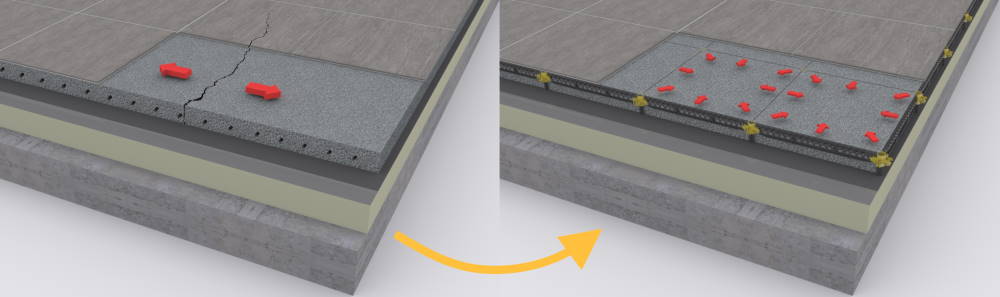
With a traditional floating screed, there is usually one continuous slab on top of the substrate or insulation layer. As soon as that slab shrinks, dries, heats up or cools down, stresses can build up across a larger area.
- The screed acts as one large field, allowing movements to reinforce each other.
- Shrinkage and temperature differences build up stress in the screed.
- If that stress has nowhere to go, it can lead to cracks in the screed or damage that transfers into the tiled floor.
- That is why traditional solutions often require joints, reinforcement and minimum thicknesses to reduce the risk.
What does the Staenis screed grid do differently?
The Staenis grid changes the behaviour of the floor build-up. Instead of one large, continuous screed slab, you get many small compartments. Each field can process its shrinkage and small movements locally, making it harder for stresses to travel across the entire floor.
This is the same logic behind the technical advantages of the Staenis grid with screed: not only trying to make the screed stronger, but above all making the stress build-up smaller.
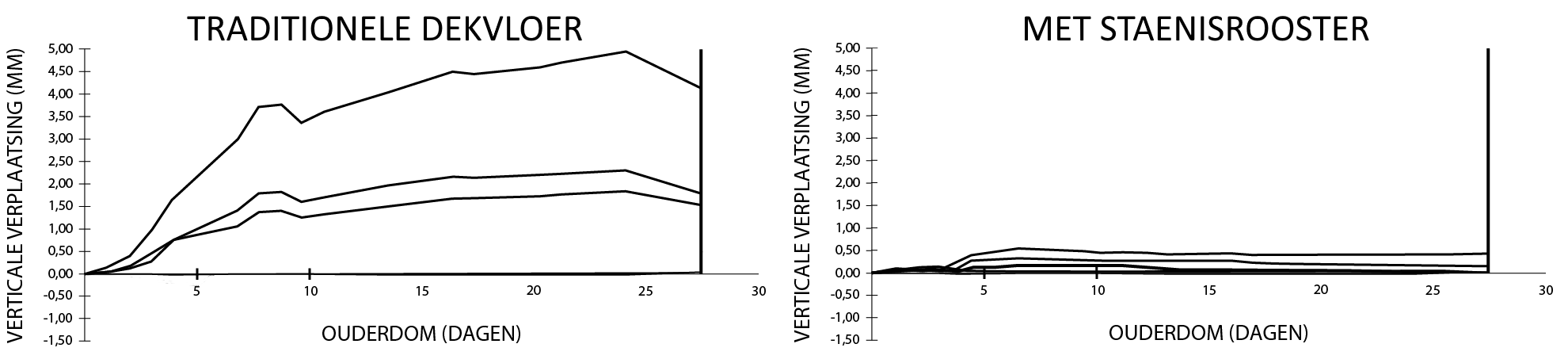
What does that solve in practice?
The benefit is not one isolated trick, but the combination of compartmentalisation, flatness and a better distribution of movements and loads.
-
Shrinkage stresses stay smaller
Because every cell is small, shrinkage can settle locally. Large stress fields build up less easily, reducing the risk of cracks. -
Stresses travel less far
In a traditional screed, a crack or stress can continue through the field. In a grid build-up, that movement is interrupted at the cell edges. -
The floor build-up depends less on material strength alone
With traditional screed, the material itself has to absorb many stresses. With the grid, the structure helps too, making the discussion about one strength class less central. -
Less thickness can become possible in the right build-up
Because you are not working with one large spanning field, a lower build-up height can be possible when the chosen floor build-up, load and finish allow it. -
Point loads are distributed better
The grid helps limit local deformation and distributes loads across the floor build-up. That lowers the risk of indentation and cracking.
Why the F-class discussion becomes less central
That does not mean the F-class or product choice is unimportant. The screed still has to match the floor build-up, loads and finish. The difference is that the grid does not rely only on stronger material: it first limits the stress build-up that can lead to damage. This explanation therefore also supports our articles about reinforcement in screed and decoupling.
We do not make the screed stronger, we make the problem smaller.
The short summary
Traditional screed mainly tries to resist stresses. The Staenis grid ensures that those stresses cannot build up as much. This makes the floor build-up more robust, flatter and less sensitive to continuous crack formation.
Want to know whether this fits your project? View the technical advantages, choose your floor build-up or calculate your materials with the calculator.