Specification texts & spec writing guide for Staenis systems and CircoFloor
By Staenis | | Manual
Are you drafting a specification for a residential project, apartment building, renovation or light utility application? This guide helps architects, engineering consultancies, specifiers, project developers and contractors include Staenis systems and CircoFloor in a traditional Belgian specification more quickly, more clearly and more project-specifically.
Would you also like to consult the official technical specification texts of the Flemish government? On the page Bouwtechnisch bestek 2025 - teksten you can download the relevant documents and use them as an additional reference when drafting your file.
On this page you will find practical specification guidance for Staenis Screed Grid, Staenis Dry Floor Grid, Staenis Compound Levelling Grid and CircoFloor. You can immediately see which sections these systems usually belong to and use the model texts as a workable basis for project-specific specification clauses.
Important: these model texts have deliberately been drafted as a workable basis for design teams. The final wording, performance requirements, method of measurement and application conditions remain project-specific and must always be validated against the actual floor build-up, loads, acoustic requirements, thermal requirements, fire safety requirements, moisture behaviour and the applicable technical documentation.
Where do the systems fit in the specification?
Use the mapping below as a quick starting point. The final section always depends on the function of the layer, the selected materials and the actual project build-up.
Staenis Screed Grid (wet system / cementitious screed)
- Primary: 52.50 cementitious screeds - general.
- Most typical: 52.53 cementitious screeds - floating.
- Project-dependent: 52.52 unbonded or 52.51 bonded, depending on the build-up and design choice.
Staenis Dry Floor Grid (dry floor build-up)
- Primary: 52.14 insulating fill layers - dry granulates, when dry granules or dry fill are part of the build-up.
- Primary: 52.80 dry screeds - general and 52.81 dry screeds - floating with board material.
- Additional: where relevant, also specify sections for underlying acoustic or thermal layers and for the final floor finish (53.xx).
Staenis Compound Levelling Grid (levelling / thickness control)
- Staenis Compound Levelling Grid is usually included under the section of the selected levelling or screed mortar.
- In most cases this is 52.50 cementitious screeds, 52.60 calcium sulphate screeds or an additional execution clause within the section of the selected levelling layer.
- Important: the final section depends on the binder type and on the function of the layer: filling, levelling or screed.
CircoFloor (dry, modular / circular floor system)
- Primary: 52.14 insulating fill layers - dry granulates, when dry granules or a fill layer are part of the build-up.
- Primary: 52.80 dry screeds - general and 52.81 dry screeds - floating with board material.
- Project-dependent additional: sections for acoustic or thermal layers (52.30 / 52.40) and for the floor finish (53.xx).
Key specification points to consider
A strong specification clause does not only describe the grid or system itself, but above all the performance, compatibility and boundary conditions of the entire floor build-up.
Brand name or equivalent
In public or competitive dossiers you will usually work with “Staenis / CircoFloor or equivalent”. Always add clear functional and technical criteria such as adjustability, compatible build-up, load distribution, flatness, acoustic performance and execution conditions.
Define performance requirements on a project basis
Always define the required performances on the basis of the actual dossier and substantiate them with technical documentation, test reports or certificates where required.
- Build-up height and available tolerances per room or zone.
- Point loads and distributed loads, including any heavier local loads.
- Flatness, level and admissible tolerances in function of the floor finish.
- Acoustic performance, impact sound and airborne sound where relevant.
- Thermal performance, insulation values and compatibility with the insulation package.
- Reaction-to-fire and fire safety requirements according to the project dossier.
- Moisture behaviour, drying conditions and sensitivity of substrate and finish.
- Compatibility with underfloor heating, service lines and minimum cover depths.
- Type of board material, finish layer and assembly method of the upper build-up.
- Evidence through product documentation, test reports or certificates when required by the dossier.
Link the specification clause to the full floor build-up
Do not describe only the system in the specification, but the full build-up and the interaction between all layers:
- Substrate or load-bearing floor.
- Any moisture barrier, separating layer or covering foil.
- Thermal and/or acoustic layers.
- Fill layer, wet or dry, depending on the system.
- Grid, raster or modular system components.
- Load distribution layer in OSB, gypsum fibre, plywood or other board material.
- Floor finish such as tiles, PVC, parquet, laminate or other finishes.
- Edge strips, edge joints, movement joints and connection details.
Model specification text - Staenis Screed Grid
For a floating cementitious screed with controlled level setting and execution, Staenis Screed Grid can be included in the specification as a system component. The model text below helps you define the section and performance requirements more quickly on a project-specific basis.
Indicative position in the specification: 52.53.xxx cementitious screeds - floating - executed with a modular plastic screed grid system.
Model clause for the specification: 52.53.xxx cementitious screeds - floating - modular screed grid system (Staenis Screed Grid or equivalent) |FH|m²
Description: Floating cementitious screed executed with a modular plastic screed grid system that acts as a placement and distribution system for the screed mortar and contributes to a controlled execution of the floor build-up at the specified level. The system is applied in combination with edge insulation, separating layers, any thermal or acoustic insulation and the specified floor finish. The screed grid system is submitted for approval to the designer in advance, together with the technical documentation and the manufacturer's installation instructions.
Measurement: Unit of measurement: m². Measurement code: net area to be executed, measured between the bare walls; openings smaller than 0.5 m² are not deducted. Nature of contract: fixed quantity (FH). Unless stated otherwise, the unit price includes all accessories, cut pieces, cutting losses, couplings and auxiliary parts for a fully functioning system.
Material: Modular grid and placement system in plastic, suitable for use in cementitious screeds and compatible with the intended floor build-up. The system is dimensionally stable, suitable for the intended substrate and build-up, and is supplied with installation instructions and conditions of use for build-up height, mortar type, installation method, edge details, curing and compatibility with underfloor heating where applicable. Accessories, couplings, edge solutions and system-related auxiliary parts form part of the system.
Specifications: Type: modular plastic screed grid system, Staenis Screed Grid or equivalent. Application: floating cementitious screed or another project-specific build-up. Build-up height and layer thickness follow drawings, bill of quantities and technical system instructions. Compatibility is required with the specified cementitious screed mortar, edge strips, any underfloor heating and the selected floor finish. Flatness and level follow the project requirements and the specification clauses of the relevant screed section.
Additional project-specific choices:
- Suitable for phased execution zones within one room, provided joint and edge details follow the design.
- Compatible with the specified acoustic build-up without rigid sound bridges.
- Compatibility with the specified underfloor heating system and compliance with minimum cover depths according to the design and applicable guidance.
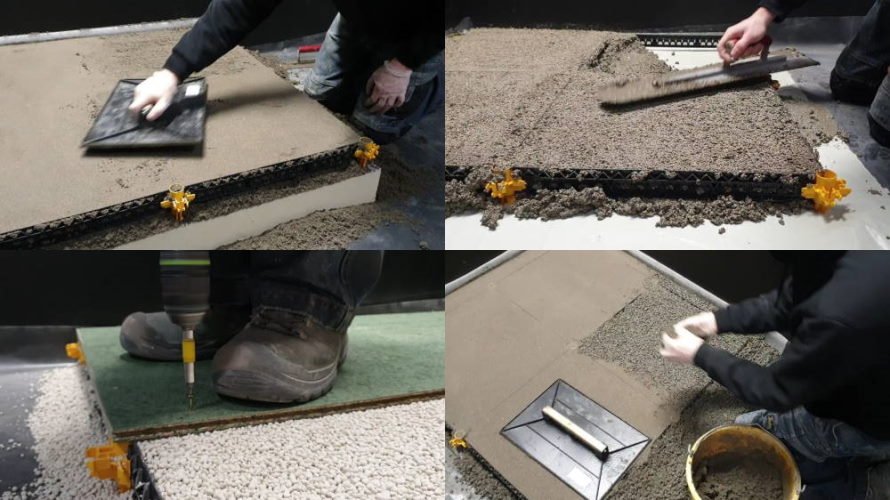
Execution: Execution of the screed follows the general provisions for cementitious screeds, supplemented by the installation instructions of the manufacturer of the screed grid system. The substrate and underlying layers are checked in advance for flatness, stability and suitability. Edge insulation, separating layers and any thermal or acoustic insulation are installed before placing the grid. The screed grid system is set at the correct level according to the intended laying pattern, including cut pieces and edge finishes. The screed mortar is introduced, compacted and finished evenly, with particular attention to corners, edges, passages and connections. Edge and movement joints are executed in accordance with the general screed requirements, the joint plan and the designer's instructions. The contractor protects the screed against overly rapid drying and observes the waiting times before further finishing.
Inspection: Checks on level, flatness and general execution are carried out according to the project requirements and the applicable screed specifications. Deviations that hinder the installation or performance of the intended floor finish are not permitted.
Application: Residential floor build-ups, renovation, new-build or other project-specific applications according to drawings and bill of quantities.
Model specification text - Staenis Dry Floor Grid
For a dry floor build-up with service lines, limited build-up height or circular ambitions, Staenis Dry Floor Grid can be split in the specification into one article for the fill layer and one article for the dry screed with board material.
52.14.xxx insulating fill layers - dry granulates - with height-adjustable plastic grid
Indicative position in the specification: Use this sub-article when dry granules or a dry fill layer determine the level and support of the floor build-up.
Description: Dry fill layer for eliminating unevenness, level differences and service lines, executed in combination with a height-adjustable plastic grid that supports and positions the further dry floor build-up. The system makes it possible to place the load distribution layer above in a controlled and level manner according to the intended floor build-up.
Measurement: Unit of measurement: m². Measurement code: net area to be executed; openings smaller than 0.5 m² are not deducted. Nature of contract: fixed quantity (FH). The price includes dry granules or fill material if included in this article, the grid, accessories, cut pieces, edge finishes and system-related auxiliary parts, unless specified otherwise.
Material: Dry insulating or levelling granulates according to the project specification, if included in the build-up. Height-adjustable plastic grid, suitable for dry floor build-up and compatible with the intended load distribution layer in OSB, gypsum fibre, plywood or other specified boards. Any system accessories, edge strips, covering foils and separating layers follow the manufacturer's instructions and the project requirements.
Specifications: Grid type: height-adjustable plastic grid, Staenis Dry Floor Grid or equivalent. Adjustment range follows the selected system configuration and the required build-up height. Application: dry floor build-up above the bearing floor, fill layer or service lines. Compatibility is required with the specified dry granulates, acoustic layer, thermal layer and board materials. Acoustic detailing prevents unwanted rigid sound bridges.
Additional project-specific choices:
- The dry fill layer complies with the specified bulk density and thermal conductivity according to the selected product documentation.
- The build-up is suitable for accommodating installations or service lines within the intended build-up height.
- The board layer above is only installed after checking settlement or flow of the granules in accordance with the system and project instructions.
Execution: The substrate is cleaned and prepared in accordance with the manufacturer's instructions for the system and the selected fill material. Openings, gaps and possible leakage points are sealed in advance. Edge strips and any separating or covering foils are installed according to the system instructions. The dry fill layer is applied and levelled according to the required levels. The adjustable plastic grid is placed and levelled at the correct height, taking into account the full floor build-up. The further build-up with dry floor boards follows the relevant dry screed section. Before placing the board layer, the contractor checks the stability and continuity of the underlying build-up.
Application: Dry floor build-up in renovation and new-build, in rooms with limited build-up height and/or with service lines in the floor build-up, according to drawings and bill of quantities.
52.81.xxx dry screeds - floating with board material - on adjustable plastic grid
Indicative position in the specification: Use this sub-article for the dry screed and the load distribution layer in board material on Staenis Dry Floor Grid.
Description: Dry screed with board material, floating on an adjustable plastic grid within a dry floor build-up. The dry screed forms a flat and load-bearing substrate for the intended floor finish, in accordance with the project requirements and the system manufacturer's instructions.
Measurement: Unit of measurement: m². Measurement code: net area to be executed; openings smaller than 0.5 m² are not deducted. Nature of contract: fixed quantity (FH).
Material: Adjustable plastic grid: Staenis Dry Floor Grid or equivalent. Load distribution layer in board material: OSB, gypsum fibre boards, plywood or other specified board material, according to drawings, bill of quantities and compatibility with the selected floor finish. Any additional underlays, acoustic felt strips, foils, fasteners, screws, adhesives and system accessories follow the instructions of the board manufacturer and the system.
Specifications: Board material, thickness, number of layers and installation method follow the project dossier. The build-up is aligned with the intended service load and floor finish. Flatness complies with the requirements of the final finish and the project tolerances. Edge detailing provides the required perimeter joint or edge strip according to the acoustic and building physics requirements.
Additional project-specific choices:
- Two-layer board build-up with staggered joints.
- Tongue-and-groove boards bonded together in accordance with the manufacturer's instructions.
- Extra attention to edge support, cut pieces and connections to walls, door openings and penetrations.
Execution: Installation follows TV 193 for dry screeds, the instructions of the board manufacturer and the instructions of the grid manufacturer. The grid is checked in advance for level, stability and correct support. The boards are installed in the prescribed pattern with correct support of edges and joints. The required perimeter joint is provided along all upstands. Openings and cut-outs are finished neatly without jeopardising the stability of the build-up. The dry screed is protected from damage and moisture before the final finish is installed.
Application: Dry floor build-up for residential and light utility applications, according to drawings and bill of quantities.
Model specification text - Staenis Compound Levelling Grid
It is best to include Staenis Compound Levelling Grid as a sub-article or additional execution clause under the section of the selected mortar or levelling layer. This keeps it clear that the grid is a system component within the execution of that layer.
Indicative position in the specification: 52.5x.xxx / 52.6x.xxx screed or levelling layer - with plastic levelling grid (Staenis Compound Levelling Grid or equivalent).
Description: Thicker levelling, height-correction or project-specific screed layer executed with a plastic levelling grid as an aid for controlled layer build-up, levelling and execution, in combination with the prescribed mortar or levelling compound. The system is applied within the intended floor build-up and according to the manufacturer's technical instructions.
Measurement: Unit of measurement: m². Measurement code: net area to be executed; openings smaller than 0.5 m² are not deducted. Nature of contract: fixed quantity (FH), unless otherwise determined in the relevant section.
Material: Plastic levelling grid: Staenis Compound Levelling Grid or equivalent. Mortar or levelling compound follows the relevant main section in terms of binder, performance and application conditions. System accessories and auxiliary parts are supplied according to the manufacturer.
Specifications: Type: plastic levelling grid for use in levelling or screed layers. Layer thickness and build-up height follow drawings, bill of quantities and system instructions. Compatibility is required with the selected mortar or levelling product and with the substrate. Flatness and level follow the project requirements and the main section of the relevant levelling or screed layer.
Additional project-specific choices:
- Application in renovation floors with limited build-up height.
- Application for local correction of level differences.
- Application in combination with specific finish requirements where increased flatness is required.
Execution: Execution follows the main section of the selected mortar or levelling layer, supplemented by the instructions of the manufacturer of the levelling grid. The substrate is checked for stability, bond, cleanliness and suitability. Any primers, separating layers or edge strips are installed according to the instructions of the mortar or levelling producer and the system manufacturer. The levelling grid is placed according to the prescribed pattern and level. The mortar or levelling layer is applied, spread and finished according to the required flatness, layer thickness and curing conditions. Drying and waiting times are strictly observed before further finishing.
Application: Renovation, levelling, screed repair or other project-specific floor build-ups according to drawings and bill of quantities.
Model specification text - CircoFloor
For a dry, modular and circular floor build-up, CircoFloor can be included in the specification as a system solution. The clause below starts from the logic of dry screeds, while deliberately remaining open to project-specific refinement.
Indicative position in the specification: 52.80.xxx / 52.81.xxx dry screed - modular circular floor system (CircoFloor or equivalent).
Description: Dry floor build-up executed as a modular and demountable or circular floor system with adjustable and/or modular system components, aligned with the intended build-up height, services in the floor build-up and the required floor finish. The system forms a flat, stable and maintenance-friendly substructure and is installed according to the manufacturer's system instructions. Before execution, the system is submitted to the designer for approval with the build-up scheme, compatible underlays and board materials, edge details, assembly and disassembly principles, conditions of use and limitations.
Measurement: Unit of measurement: m². Measurement code: net area to be executed; openings smaller than 0.5 m² are not deducted. Nature of contract: fixed quantity (FH), unless stated otherwise. Included are system components, accessories, cut pieces, fixings, edge solutions and all auxiliary parts required for complete execution.
Material: Modular floor system: CircoFloor or equivalent, with system components in accordance with the manufacturer's technical documentation. Any acoustic or thermal underlays, dry fill or granulates, load distribution layers and board materials are selected according to the project build-up and compatibility with the system and floor finish. System accessories, fixings and edge details follow the manufacturer's instructions.
Specifications: Type: modular dry floor system with a circular and demountable concept, to be detailed per project. Build-up height follows drawings and bill of quantities. Use and load capacity are aligned with the specified service load of the project. Compatibility is required with the substrate, underlays, board materials and floor finish. Flatness and level are aligned with the requirements of the final finish. Acoustic detailing avoids unwanted sound bridges.
Additional project-specific choices:
- Reversible or demountable build-up as an explicit project objective.
- Dry assembly without wet screed works.
- Integration of service lines and installations within the floor build-up.
- Reduction of drying times in view of fast further finishing.
Execution: Execution follows TV 193 for dry floors where applicable, supplemented by the manufacturer's instructions for the CircoFloor system. The substrate is checked for stability, flatness, cleanliness and dimensions. Any foils, edge strips, acoustic or thermal underlays are installed according to the project build-up. System components are placed and adjusted according to the intended level and laying plan. Cut pieces and connections to walls, columns, door openings and penetrations are carefully finished. The load distribution layer or board layer is installed according to the system instructions and the requirements of the intended finish. The executed floor build-up is protected against damage and moisture until the finish is installed.
Inspection: Checks are carried out on level, flatness, stability and conformity with the approved build-up. Defects that hinder the installation or performance of the finish floor are remedied before further finishing.
Application: Renovation and new-build projects in which a dry, modular and project-configurable floor build-up is required.
Additional project information that should be included in the dossier
To specify a Staenis or CircoFloor system correctly, it is strongly recommended to also include the following project information in drawings, details or bills of quantities:
- Project type: renovation, new-build, residential or utility.
- Bearing floor: concrete, timber, existing floor or a mixed situation.
- Available build-up height per room or zone.
- Presence of service lines, ducts, penetrations or technical zones.
- Required floor finish: tiles, PVC, parquet, laminate or another finish.
- Acoustic requirements for impact sound and airborne sound.
- Thermal requirements and the intended insulation package.
- Moisture sensitivity of the room and building-physics considerations.
- Underfloor heating: yes or no, and which build-up conditions apply.
- Loads: residential use, heavier point loads or technical rooms.
- Required flatness and finish tolerances.
- Phasing, planning and target execution period.
- Any requirement regarding demountability, reuse or circularity.
Suggested wording for “or equivalent”
When you mention a brand name in a dossier, also define the functional, technical and execution criteria that must at least be achieved.
“Staenis [product name] / CircoFloor or equivalent, provided the proposed system demonstrably complies with the functional, technical and execution criteria included in this specification, and provided it is compatible with the intended floor build-up and finish.”
Disclaimer
These specification texts are model texts and serve as a practical basis for project-specific specifications. They speed up dossier drafting, but they do not replace design responsibility, project validation or technical verification.
The final choice of section, wording, performance requirements and execution instructions is made by the designer and the project team on the basis of the specific project, the applicable standards and guidance, the relevant technical documentation and the manufacturer's current product information.
Quick decision aid
Use this as a short memory aid for the initial section choice:
- Wet cementitious screed build-up? - Staenis Screed Grid - usually 52.53.
- Dry build-up with board material and service lines or fill? - Staenis Dry Floor Grid - usually 52.14 + 52.80/52.81.
- Levelling with a grid inside a mortar layer? - Staenis Compound Levelling Grid - include it under the section of the selected levelling or screed mortar.
- Dry, modular and circular system? - CircoFloor - usually 52.14 + 52.80/52.81.
Do you need a project-specific specification clause or a validation of the floor build-up for a concrete project? Contact Staenis and share plans, build-up height, service routing and the intended floor finish for targeted support.