At 60 cm rail distance
60x60, 60x90, 60x120
In this situation, CircoFloor is approximately in the same price range as an aluminium rail system. Depending on the chosen configuration, the system may be slightly cheaper or slightly more expensive.
Turn your roof terrace into a stable, homogeneous floor instead of a tile field on loose legs.
Classic tile pedestals are a good solution for simple roof terraces. But as soon as you work with larger tiles, staggered joints, natural stone, small fitting pieces or higher comfort expectations, a normal construction with loose supports is often limited.
CircoFloor forms a linked substructure under the terrace tiles. The tiles are not only located at four separate points, but are supported by a fine-mesh grid. This makes the terrace feel fuller and more stable, joints stay better in place and edges and small tile pieces also receive better support.
CircoFloor is not intended as a cheapest alternative to regular tile pedestals. For a simple roof terrace with standard ceramic tiles, classic tile pedestals often remain the most economical choice.
CircoFloor becomes interesting when you expect more from the terrace floor: more stability, a fuller walking feeling, better support of fitting pieces, less risk of sliding joints and a substructure that feels more like a whole.
That is why we mainly compare CircoFloor with premium systems on tile pedestals with aluminium rails. Where aluminium rails try to create a more stable line support from separate beams, CircoFloor immediately starts from a linked floor structure.
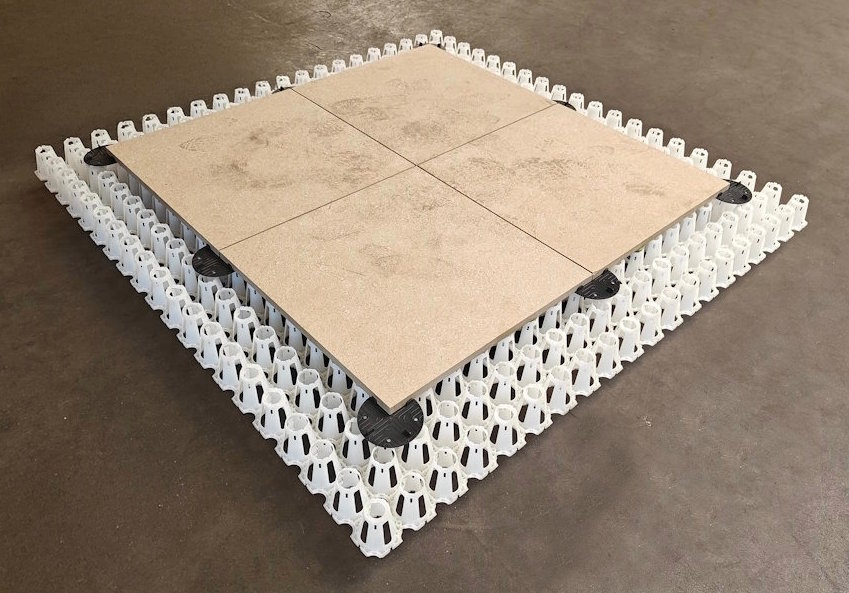
For a simple roof terrace with 60 x 60 cm ceramic tiles on regular loose tile pedestals, the classic solution usually remains the cheapest choice. In that case, CircoFloor is primarily a premium solution for those who want more stability, a fuller walking feeling and better support.
The comparison changes as soon as ordinary tile pedestals become technically less interesting and people switch to aluminium rail systems. This often happens with elongated tiles, staggered joints, large formats, natural stone or many fitting pieces on edges and facades.
In these situations, a classic system often has to be constructed with tile pedestals, aluminium rails, special heads, joints, connectors, rubbers and additional accessories. The smaller the tile size or the more complex the laying pattern, the closer the rails are to each other and the more material costs increase.
CircoFloor starts from a different principle: a linked grid under the tiled floor. As a result, the substructure remains fine-meshed and homogeneous, without the need to add additional aluminum lines per tile size.
60x60, 60x90, 60x120
In this situation, CircoFloor is approximately in the same price range as an aluminium rail system. Depending on the chosen configuration, the system may be slightly cheaper or slightly more expensive.
45 x 90, 90 x 90 with extra support
When the rail system needs to be placed closer, CircoFloor becomes clearly more interesting. In our reference estimate, CircoFloor can be approximately 20-27% cheaper here.
40 x 80, 40 x 120, 80 x 80 with extra support
With a denser rail grid, the number of running meters of aluminum and the number of carriers increases. CircoFloor can be approximately 27-35% cheaper in this situation.
30 x 60, 30 x 120, plank formats, strongly offset pattern
With plank formats or narrow tiles, an aluminium rail system quickly becomes material-intensive. In our reference estimate, CircoFloor can be approximately 43-50% cheaper here.
| Situation | Classic rail system | CircoFloor | Conclusion |
|---|---|---|---|
| 60 x 60 cm or 60 x 120 cm | Efficient rail grid with greater spacing | Coupled grid with homogeneous support surface | Approximately equivalent material cost |
| 45 x 90 cm or 90 x 90 cm | More rails and supports needed | Same linked grid structure | Approx. 20-27% cheaper in our reference estimate |
| 40 x 80 cm, 40 x 120 cm or 80 x 80 cm | Closer rail grid needed | No additional aluminum lines per tile size | Approx. 27-35% cheaper in our reference estimate |
| 30 x 60 cm, 30 x 120 cm or plank connection | Much denser rail grid needed | Fine-grained support from the system itself | Approx. 43-50% cheaper in our reference estimate |
With an aluminium rail system, the price is strongly determined by the number of running meters of rail per square meter. With a rail spacing of 60 cm, approximately 1.67 running meters of rail are required per m2. With a rail spacing of 30 cm, this becomes approximately 3.33 running meters of rail per m2. The number of rails, carriers and accessories is therefore increasing rapidly.
CircoFloor works differently: the system forms a linked grid over the entire surface. As a result, the substructure changes much less significantly when the tile size or laying pattern changes.
CircoFloor is not intended as a cheapest alternative to regular loose tile pedestals. The correct comparison is with premium terrace build-ups where aluminium rails are otherwise required. CircoFloor becomes technically and financially interesting especially with staggered joints, elongated tiles, large formats and many fitting pieces.
| Solution | Support | Advantage | Restriction |
|---|---|---|---|
| Ordinary tile pedestals | Puntvormig | Cheap and simple | More chance of hollow feeling, wobbly tiles, shifting joints and difficult edge areas |
| Tile pedestals with aluminium rails | Lijnvormig | Better for staggered joints and large tiles | Many parts, separate carriers are still required, higher system costs |
| CircoFloor roof terrace construction | Fine-meshed linked grid | Homogeneous, fuller and more stable feeling; better support for tiles and fitting pieces | Not intended as a price competitor to regular loose tile pedestals |
The roof terrace structure consists of a linked CircoFloor grid, adjustment screws, protective plates under the adjustment screws and rubber tile plates with spacer at the top. This creates a dry, demountable and stable substructure for ceramic patio tiles or natural stone.
The existing roof waterproofing or substrate remains intact. When used on a roof, the roof structure must always be suitable for the intended load and water drainage must be maintained.
A round protective plate is placed under the adjustment screws. This distributes the pressure and prevents the adjustment screw from having to be fixed directly in the roof waterproofing or substrate. This way, the terrace structure can be installed without piercing the roof waterproofing.
The CircoFloor grille is height-adjusted with adjustment screws. The structural plates click together to form a linked whole. This creates a stable supporting structure that is less dependent on loose support points than classic tile pedestals.
Rubber tile plates are placed on top of the grid. These ensure stable contact between tile and grid, help limit shifting and automatically maintain a 3 mm joint between the tiles.
The finish consists of ceramic patio tiles or natural stone. Ceramic tiles are the most standard. With natural stone, the tile size, thickness, bending strength and project situation must always be taken into account.
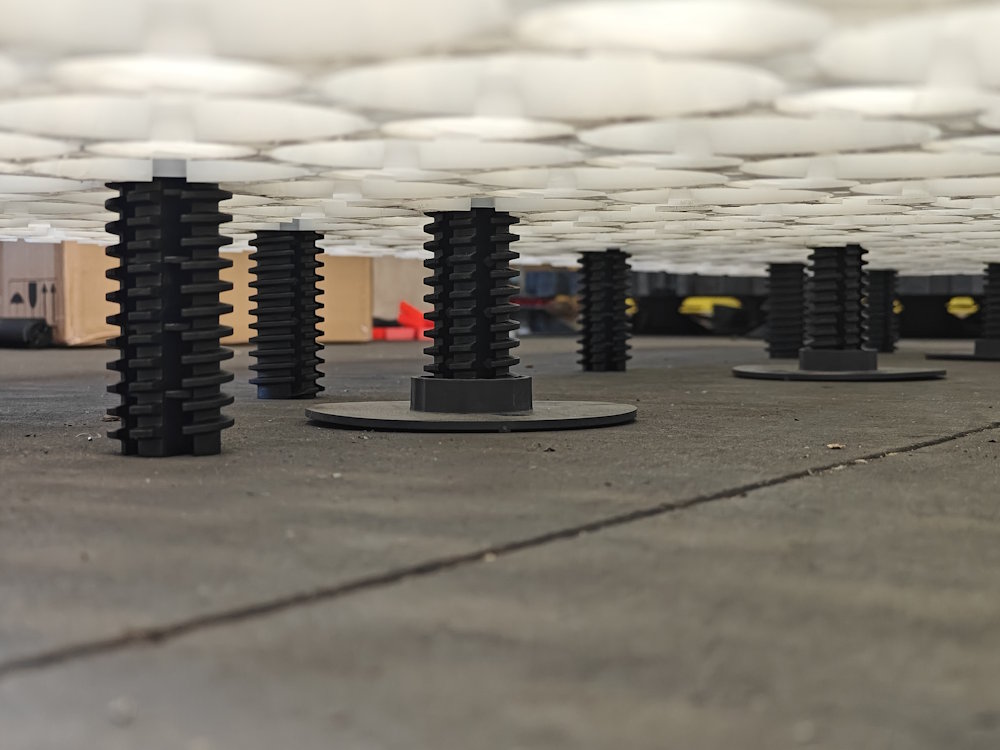
For roof terraces where the substrate may not be pierced.
In classic CircoFloor applications, the system can be mechanically attached to the substrate. You don't want to pierce the roof waterproofing on a roof terrace. That is why a protective plate is placed under the adjustment screw. This distributes the pressure, protects the roof waterproofing and allows the CircoFloor structure to be installed dry and without perforations.
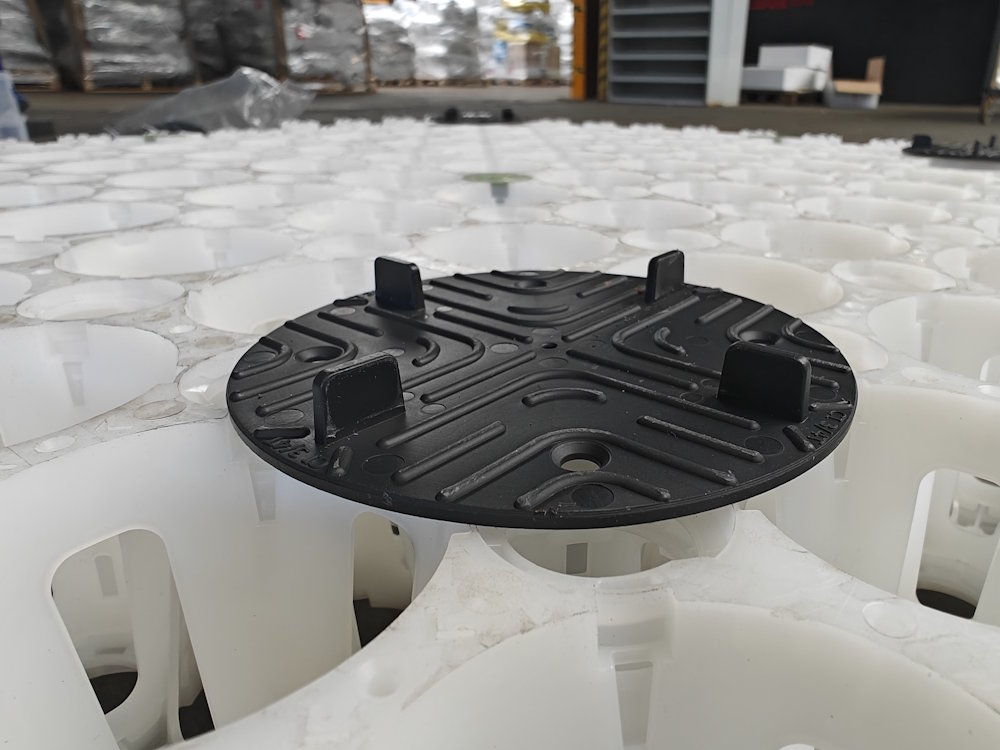
For stable patio tiles and even joints.
The rubber tile plate is placed on top of the CircoFloor grid. The rubber ensures a more stable contact with the tile and helps to limit shifts. The integrated spacer maintains an open joint of 3 mm, so that the tiles remain neatly aligned and water can drain between the tiles.
With regular tile pedestals, each tile stands on separate legs. At CircoFloor, the structural panels together form a linked substructure, which helps limit the risk of loose, wobbly or shifting tiles.
A terrace on loose tile pedestals can feel hollow or technical. CircoFloor distributes the load over the connected grid and therefore feels more like a real floor.
Aluminium rails are often used for staggered joints. CircoFloor offers a fine-meshed, linked structure on which tiles can be placed more flexibly.
Narrow tile strips on facades, walls, upstands and edges are often weak zones for tile pedestals. With CircoFloor, smaller pieces also receive better underlying support.
With classic tile pedestals, a tile often spans large open zones between four support points. At CircoFloor there is a more finely meshed grid under the tile. A damaged tile must of course be replaced.
With protective plates under the adjustment screws, the structure can be used without drilling into the roof waterproofing. This is important for roof terraces, balconies and renovations.
The structure is installed dry and can later be opened again, adjusted or dismantled. This is useful for maintenance, renovation or future terrace adjustments.
The figures below help to position the roof terrace structure correctly. The final application remains project dependent.
Natural stone on classic tile pedestals requires extra attention, because the tile often has to bridge large distances between four support points. With CircoFloor, the tile is much more finely supported by the grid. The largest free openings are much smaller than the span between classic tile pedestals.
This means that CircoFloor can be interesting for natural stone or more sensitive materials. Yet natural stone remains a natural product. The minimum thickness depends on the stone type, tile size, flexural strength and application.
We therefore always recommend a project-based check or test setup for natural stone, especially with heterogeneous or less flexible stone types.
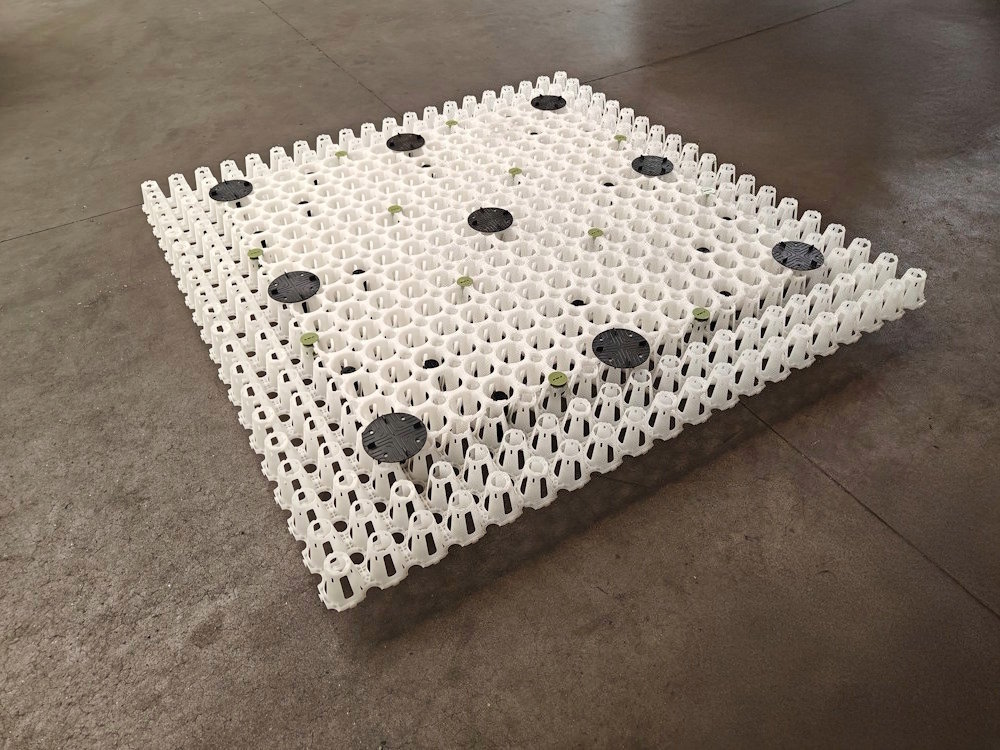
For simple, standard roof terraces with ceramic 60 x 60 cm tiles and without special requirements, ordinary tile pedestals often remain the cheapest solution.
You choose CircoFloor when stability, walking comfort, support, edge finishing and a high-quality floor experience are more important than the lowest system price.
Check whether the roof waterproofing, slope, drainage and supporting structure are suitable for the intended terrace construction. The roof waterproofing must not be damaged during installation.
Place the CircoFloor protective plates on the positions of the adjustment screws. This distributes the pressure and prevents penetration of the substrate.
Click the CircoFloor structural panels together and adjust the height with the adjustment screws. Make sure the grille is stable, level and well supported.
Place the rubber tile plates with integrated 3 mm spacer on the correct tile positions. These ensure stable contact and even joints.
Place the ceramic tiles or natural stone on the grid. During installation, regularly check the joint line, stability, edge pieces and water drainage.
Pay extra attention to edges, facades, upstands and small tile pieces. This is precisely where CircoFloor offers an important advantage over separate tile pedestals.
For use on roof terraces, the entire roof structure must always be taken into account. CircoFloor prevents penetration of the roof waterproofing with protective plates, but the roof structure, roof waterproofing, pressure distribution, wind load, edge retention and water drainage must always be assessed on a project-by-project basis.
With natural stone, the suitability of the tile must be confirmed based on the stone type, thickness, size and flexural strength. If in doubt, we recommend a test setup.
Not with simple standard terraces. For 60 x 60 cm ceramic tiles on regular loose tile pedestals, the classic solution is usually cheaper. CircoFloor is primarily a premium solution for more stability, comfort and support.
CircoFloor becomes financially interesting when an aluminium rail system is otherwise needed, for example with elongated tiles, staggered joints, large formats, natural stone or many fitting pieces. In those situations, according to our reference estimate, CircoFloor can be approximately equivalent to significantly cheaper.
With smaller or elongated tiles, aluminium rails often need to be placed closer together. This increases the number of running meters of rail, the number of tile pedestals and the number of accessories per square meter.
Especially with 30 x 60 cm, 30 x 120 cm, 40 x 80 cm, 40 x 120 cm, 45 x 90 cm, 80 x 80 cm, 90 x 90 cm, plank formats and staggered connections. These are situations where ordinary tile pedestals often become technically less interesting and aluminium rails are considered.
No. The percentages are indicative and based on a reference estimate. The exact difference depends on tile size, laying pattern, height, edge finish, accessories, project size and chosen configuration. Therefore, always request a project-oriented comparison.
Tile pedestals with aluminium rails turn point supports into line support. CircoFloor goes further and forms a linked grid under the tiles. This makes the floor feel more homogeneous and edges, fitting pieces and offset joints are also better supported.
Yes, with protective plates under the adjustment screws the superstructure can be installed without piercing the roof waterproofing. The pressure is distributed via the protective plate. The suitability of the roof waterproofing and roof structure must always be checked on a project-by-project basis.
The rubber tile plates ensure a more stable contact between tile and grid. They help limit shifting and have an integrated 3mm spacer for an even open joint.
Natural stone can be interesting on CircoFloor because the tile is supported more finely than on classic tile pedestals. However, natural stone must always be assessed on a project basis based on stone type, thickness, size and bending strength.
With classic tile pedestals, a tile often only rests on four points, with large open zones in between. At CircoFloor there is a more finely meshed grid under the tile. This means that a supporting structure remains under a cracked tile. The tile obviously needs to be replaced.
Yes. The tile joints remain open and the CircoFloor grid has an open structure. The slope and drainage of the roof must be correctly designed and maintained.
This structure is especially suitable for high-quality roof terraces, balconies, apartments, penthouses, natural stone terraces, terraces with large tiles, staggered joints or many edge and fitting pieces.
With CircoFloor you can turn a terrace on separate support points into a stable, linked floor structure. Ideal for projects where comfort, stability and durable installation are important.