Renovation floor build-up with limited build height in Europe
By Staenis | | Manual
Looking for a renovation floor build-up with limited build height in Europe? This guide answers that exact question: which low floor build-up should you choose when every centimetre matters? The right choice is rarely just "the thinnest floor"; you also need to consider the existing substrate, pipes, weight, drying time, insulation, underfloor heating and final floor finish.
Short answer
With limited build height, you usually avoid a classic thick floating screed. Instead, you look at a thin bonded screed or levelling compound, a tileable insulation screed, a lightweight dry floor or a dry underfloor heating system. The right option depends on what is under the floor and how much height you really have.
Which floor build-up suits limited height?
Staenis always starts from the complete floor build-up. A renovation on a flat concrete slab is different from an old timber joist floor, an existing tiled floor or a substrate with pipes. Use the table below as a first decision aid, then check the detail page for the chosen solution.
Not sure yet? Start with the floor build-up overview or make a first estimate with the Staenis calculator.
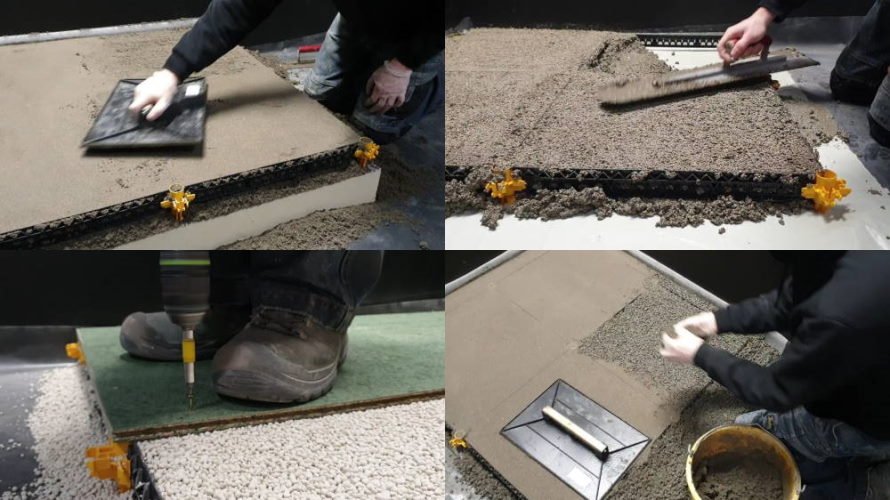
Comparison: low floor build-up for renovation
| Solution | Typical height | Best for | Watch out for | Next step |
|---|---|---|---|---|
| Levelling compound or thin levelling layer | From 1 mm; practical mainly for small corrections. Some systems can go higher, but that quickly becomes expensive. | An almost flat concrete, screed or tiled substrate that still needs precise levelling. | Levelling compound is not a solution for large height differences, pipes or soft substrates. | View levelling compound and the levelling grid |
| Thin bonded screed | About 1 to 5 cm, when the substrate is stable and correctly prepared. | Renovations with a few centimetres available where a bonded cement-based layer is more logical than thick levelling compound. | The substrate must be hard, clean and properly primed. Do not use it as a floating build-up. | Read about minimum screed thickness |
| Classic screed in the Staenis screed grid | Usually closer to 5 to 8 cm, depending on bonded, unbonded, floating or underfloor heating build-up. | A strong screed for tiles, parquet, laminate or other floor finishes. | A floating screed, underfloor heating or garage load requires more height. Do not calculate blindly with 1 cm. | View screed build-ups |
| Tileable insulation screed | From about 4.5 cm in the Staenis screed grid, plus primer, levelling/adhesive layer and tile. | Low renovation build-ups where you want a light, insulating and directly tileable solution. | Not the same as standard insulation screed. Higher loads or other finishes need extra assessment. | View insulation screed |
| Dry floor with Staenis dry floor grid and board | From about 6.3 cm: dry floor grid height plus OSB, Durelis or another suitable board layer. | Attics, timber floors, renovations with limited load capacity or situations without drying time. | Do not use this as a screed grid: the Staenis dry floor grid is intended for dry fillers or no filler with OSB, Durelis or suitable board layers. The board build-up determines stiffness; non-load-bearing granules often require double boards. | View dry floor build-ups |
| Dry underfloor heating | Depending on brand and system sometimes very low, but always on a flat, stable base. | Renovations where underfloor heating is wanted and wet screed is too high, too heavy or too slow. | Always check the substrate, heat output, floor finish and the instructions of the underfloor heating system. | Compare dry underfloor heating |
| CircoFloor | For higher dry renovation build-ups, typically around 9 to 22 cm or more depending on structure and finish. | Renovations with larger height differences, need for insulation, acoustics, circularity and no drying time. | Not the lowest solution, but useful when you need to bridge height without wet screed. | Discover CircoFloor |
Heights are indicative. The real floor height always includes the substrate, any foil/primer, grid or system layer, filler, board layer, adhesive and final floor finish. Always check the complete build-up for each project.
Always check local rules, standards, availability, subsidies and installation instructions for your country or region. This guide is based on technical Staenis systems and does not replace project-specific advice.
Which situation do you recognise?
Your existing floor is almost right
For small height differences, levelling or a thin bonded screed is often the shortest route. This works mainly on a hard, stable and clean substrate.
You have little height but want tiles
Then tileable insulation screed is interesting: light, insulating and, in the right build-up, directly finished with primer, levelling layer or tile adhesive and tiles.
Your floor must not become too heavy
On an upper floor, attic or timber structure, look at insulation screed with boards, a dry floor with Staenis dry floor grid or CircoFloor. Weight is then just as important as height.
You want underfloor heating in renovation
A wet system in screed often needs more height. With limited height, a dry underfloor heating system can be more logical, provided the substrate is flat enough.
You have pipes or large level differences
Then you first need to solve the filling layer. At greater heights, CircoFloor or a dry build-up can be smarter than filling everything wet.
You are choosing between systems
First use the floor build-up overview, then the calculator. If you are unsure about load capacity, moisture or underfloor heating, it is safer to ask for advice.
Main points when build height is limited
- Measure the available height only after checking the substrate. A floor that is 2 cm out of level needs more correction than it first seems.
- A low floor build-up still needs to be strong. The final floor, furniture, kitchens and point loads help determine which layer is suitable.
- Underfloor heating changes the choice. Wet underfloor heating in screed needs more height than a dry board build-up.
- Levelling compound is not a cheap filler for everything. For greater heights, a thin bonded screed or another system is often more logical.
- Dry construction saves drying time. A dry floor or CircoFloor is walkable immediately, but it still requires the right board and substrate choice.
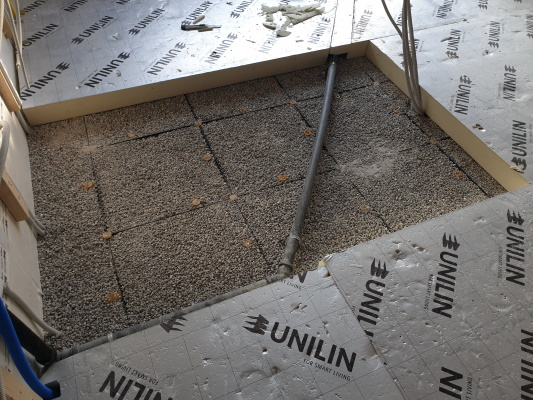
Products and next steps
In the webshop you will find the systems and fillers mentioned in this guide. Note the difference: the Staenis screed grid is for screed, insulation screed and drainage mortar; the Staenis dry floor grid is for dry floor build-ups with dry fillers or no filler and a board layer. First choose the right floor build-up and then calculate how much material you need.
| Webshop direction | When to view? |
|---|---|
| Levelling grid | For thin levelling with compound or bonded screed on a stable substrate. |
| Staenis screed grid | For screed, insulation screed or drainage mortar where you want to screed a wet or bonded layer flat yourself. Not for dry floors with a board layer. |
| Staenis dry floor grid | For dry floor build-ups with dry fillers or no filler, finished with OSB, Durelis or suitable boards. |
| Tileable insulation screed | For light, insulating renovation build-ups where tiles become the direct final finish. |
| Standard insulation screed | For lightweight filling or grid filling under a suitable board layer. |
| CircoFloor | For higher dry renovation build-ups with insulation, acoustics, load capacity and demountability. |
Frequently asked questions
Conclusion
In renovation with limited build height, there is no universal best floor. A thin floor build-up only works well when it fits the substrate and final finish. Start with the decision aid, compare the systems and only then calculate your materials.
View the floor build-up decision aid Calculate your package View bagged-material guide